
High demand homes
CleanLine Water Co. Dual Tank Softening and Filtration System in Austin, TX
A dedicated softening tank and a separate carbon filtration tank allow hardness and taste-and-odor treatment to be sized independently for the household.
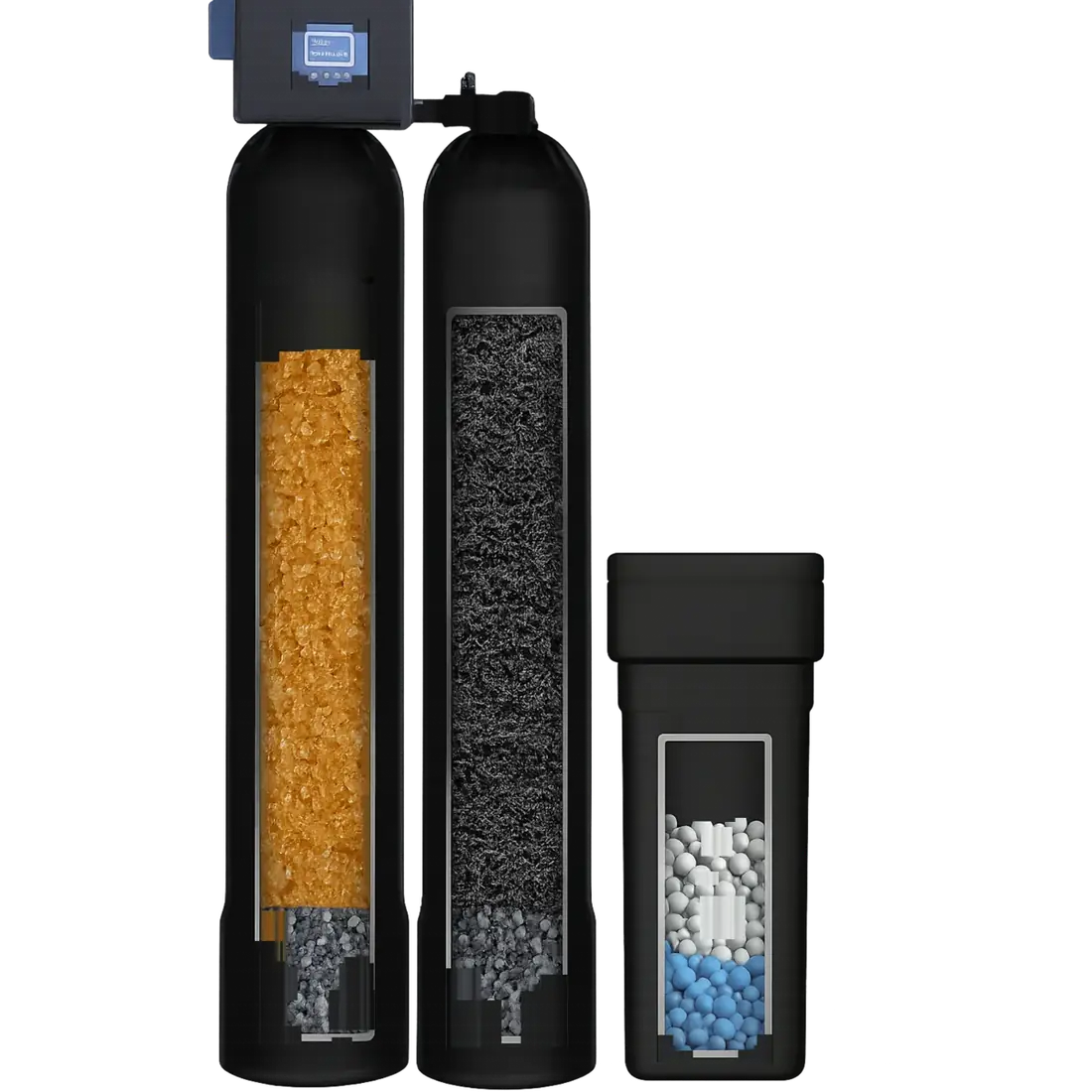
- Dedicated softening tank and dedicated carbon tank
- Longer contact time for better chloramine reduction
- Sized for four bathrooms and up, or high occupancy homes
- Separate softening and carbon beds for independent treatment and service
Benefits and treatment scope
Separate vessels for separate water problems
CleanLine's dual-tank arrangement uses a dedicated softening tank and a dedicated carbon filtration tank, plus the softener's brine tank. Keeping the media separate allows each treatment function to be sized and serviced around your water and demand.
Independent treatment sizing
Softening capacity can be chosen for hardness and consumption while carbon volume is chosen for disinfectant treatment and contact time. Bathroom count is useful context, but it is not a substitute for actual flow requirements.
Hardness and taste handled separately
The softener reduces calcium and magnesium scale potential. The carbon vessel addresses taste and odor, so homeowners can understand which tank is responsible if a symptom returns.
More straightforward media service
Separate beds allow the softening resin and filtration media to be evaluated independently. They do not have to be assumed to wear out on the same schedule.
A foundation for additional stages
Sediment treatment or tankless drinking-water RO can be included in an agreed installation scope. A private well still needs its own water analysis before this arrangement is selected.
How the equipment works
Two treatment tanks are plumbed in series, with valve heads and a bypass arrangement. One contains softening resin, the other carbon media. Only the softening resin uses brine for regeneration; two vessels do not mean two salt-consuming softeners.
What it does not do
This is not a twin-alternating softener with two resin tanks. A separate softener and carbon filter do not, by themselves, guarantee soft water throughout regeneration. They also do not replace well-water iron treatment, microbiological testing or RO for dissolved-solids reduction at the drinking faucet.
What we confirm before installation
We confirm peak flow, line size, water chemistry, equipment order and the room required for both vessels and the brine tank. Drain capacity, electrical access, bypass placement and service clearances are part of the written installation plan, not assumed from floor area alone.
Ongoing care and service
Maintain salt only in the brine tank, follow both valves' operating instructions and watch for pressure or taste changes. Backwashing carbon and regenerating resin have different functions. Service checks should evaluate each bed rather than replacing both automatically.
Specifications
- Configuration
- Two tanks plumbed in series with independent valve heads
- Tank one
- Food grade softening resin for hardness removal
- Tank two
- Carbon filtration media for disinfectant-related taste and odor; media selection confirmed for the water source
- Pre-filter
- Big housing sediment filter included on the inlet
- Flow
- Built for high demand fixtures and simultaneous use
- Install
- Garage or exterior loop, typically one full day
Who this system is built for
- Homes over roughly 3,500 square feet
- Households with five or more people
- Properties with high hardness plus strong chloramine taste
- Homes running large tubs, multiple showers or irrigation on the same line
When two tanks beat one
A combination tank is the right answer for most homes. Once demand climbs, though, the media has less contact time with the water and both softening and carbon performance start to slip during peak use.
Splitting the work into two tanks restores that contact time. Hardness removal happens in a tank sized for it, then the water gets a full pass through dedicated carbon before it enters the house.
Maintenance and long term cost
Dual tank systems consume salt at a similar rate to a single tank because regeneration is still metered to actual usage. The advantage shows up in media life: neither bed is being asked to do a second job, so replacement intervals stretch out.
Both valve heads are programmable and both tanks include a bypass, so service work never means shutting down water to the house.
Warranty and guarantee
Eligible tanks and dry parts carry lifetime coverage; control valves, circuit boards and filtration media carry 5 years under the applicable terms. Installation workmanship carries 1 year. Any included reverse osmosis equipment carries a 1 year manufacturer warranty. Consumables are separate.
Read the full warrantyFrequently asked questions
Do I need a dual tank system or is one tank enough?
Most three bathroom homes are well served by the XL Whole-Home Filter. We recommend dual tank when square footage, occupancy or measured hardness pushes demand past what a single bed handles comfortably.
Does a dual tank system use twice the salt?
No. Only the softening tank regenerates with salt, and it regenerates on metered demand rather than on a timer.
How much space does it need?
Plan on roughly four feet of wall at the loop for the two tanks and the brine tank. We ask about available space over the phone and include the proposed setup in your quote.