San Antonio runs on Edwards Aquifer groundwater, and Edwards water is some of the hardest in Texas. We size, quote and install whole-home softening built for it.
Why San Antonio Water Beats Up Plumbing
The Edwards Aquifer is a limestone formation. Every gallon that comes out of it has spent time dissolving calcium and magnesium out of the rock, and none of that mineral gets removed before the water reaches your meter. Inside your house it turns back into rock: on your heating element, inside your fixtures, across your shower glass. A water softener is the only equipment that removes hardness, and in San Antonio it is not a luxury add-on. It is the difference between plumbing that lasts and plumbing that scales itself shut.
If two or three of these sound familiar, hardness is the cause, and we can confirm it with a test at your tap before we quote anything.
White crust building up on faucet aerators and shower heads
Glass shower doors that stay hazy no matter what you clean with
Spotted dishes and glassware straight out of the dishwasher
Water heater that rumbles, heats slower or dies early
Soap and shampoo that never seem to lather
Stiff, dull laundry even with fabric softener
Who Supplies Your Water Matters
San Antonio-area homes do not all drink from the same source, and the right system depends on which one is behind your meter.
SAWS city supply
Most of San Antonio is served by the San Antonio Water System, one of the largest groundwater-based utilities in the country. Its core supply is the Edwards Aquifer, supplemented by Carrizo-Wilcox water brought in by the Vista Ridge pipeline. All of it is groundwater that has moved through limestone, and all of it arrives hard.
New Braunfels and Comal County utilities
New Braunfels Utilities and the smaller providers around Bulverde and Spring Branch blend Edwards and Trinity Aquifer wells with Canyon Lake surface water depending on the service area. The blend shifts seasonally, so hardness at the tap can move around more than people expect.
Private wells on the Hill Country edges
North and west of the city, many Comal and Bexar County properties run their own wells. Those often carry iron, sediment and sulfur odor on top of the hardness, and they need treatment staged in the right order, not a softener alone.
Softening Plus Carbon, One Installed System
Municipal supply across Bexar and Comal counties carries a chlorine or chloramine residual, and a softener alone leaves that in the water. Our whole-home system runs a high-capacity softening stage and a catalytic carbon stage together at the main line, so scale and the chemical taste are both handled before water reaches a single fixture. We test your hardness first and size the resin and carbon to the reading and your fixture count, not to a package on a shelf.
Whole-home softening and filtration is $2,799 installed with an existing garage loop. No sales tax on the installed system. Card payments carry a 3 percent processing fee; cash and Zelle payments have none.
Equipment and benefits
Compare compact treatment with separate softening and carbon tanks
For a San Antonio household, hardness removal is only one part of selecting equipment. Compare a combined vessel with separate softening and carbon beds when peak fixture demand, treatment goals and available space differ. Private-well conditions in Bexar or Comal County need a water analysis before either is chosen.
XL Whole-Home Filter
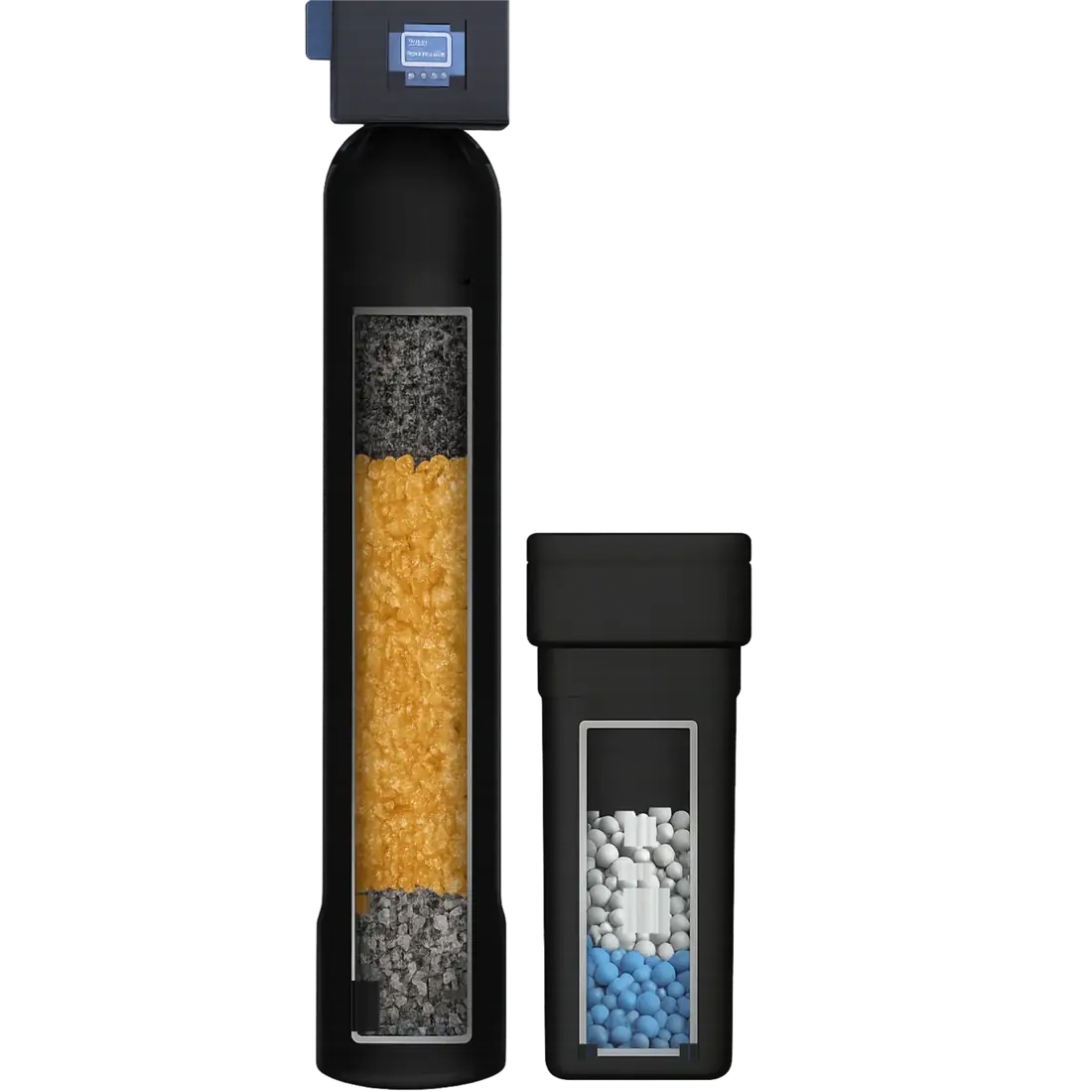
The XL combines softening resin and carbon filtration in one treatment tank, with a separate brine tank for regeneration. It is an option for homeowners who want to address hardness and disinfectant taste together while keeping the equipment arrangement compact.
Reduce hardness at treated taps: Removing calcium and magnesium helps limit new scale on shower fittings, water-heating surfaces and appliances supplied by the treated line. Existing deposits can still require cleaning or service.
Address taste and shower odor: Carbon filtration works on disinfectant-related taste and odor in addition to the resin's hardness treatment. Chloramine performance depends on the actual media and contact time, not simply the presence of a black tank.
Media
Food-grade softening resin and granular activated carbon; supplied media documentation confirmed in the quote
Targets
Hardness, chlorine, chloramine, taste and odor
Treatment limits: The XL is not reverse osmosis, UV disinfection or a dedicated iron/sulfur treatment system. Fine-particle filtration may require a separate sediment cartridge. Larger peak-flow demands may favor separate softening and carbon vessels after sizing is reviewed.
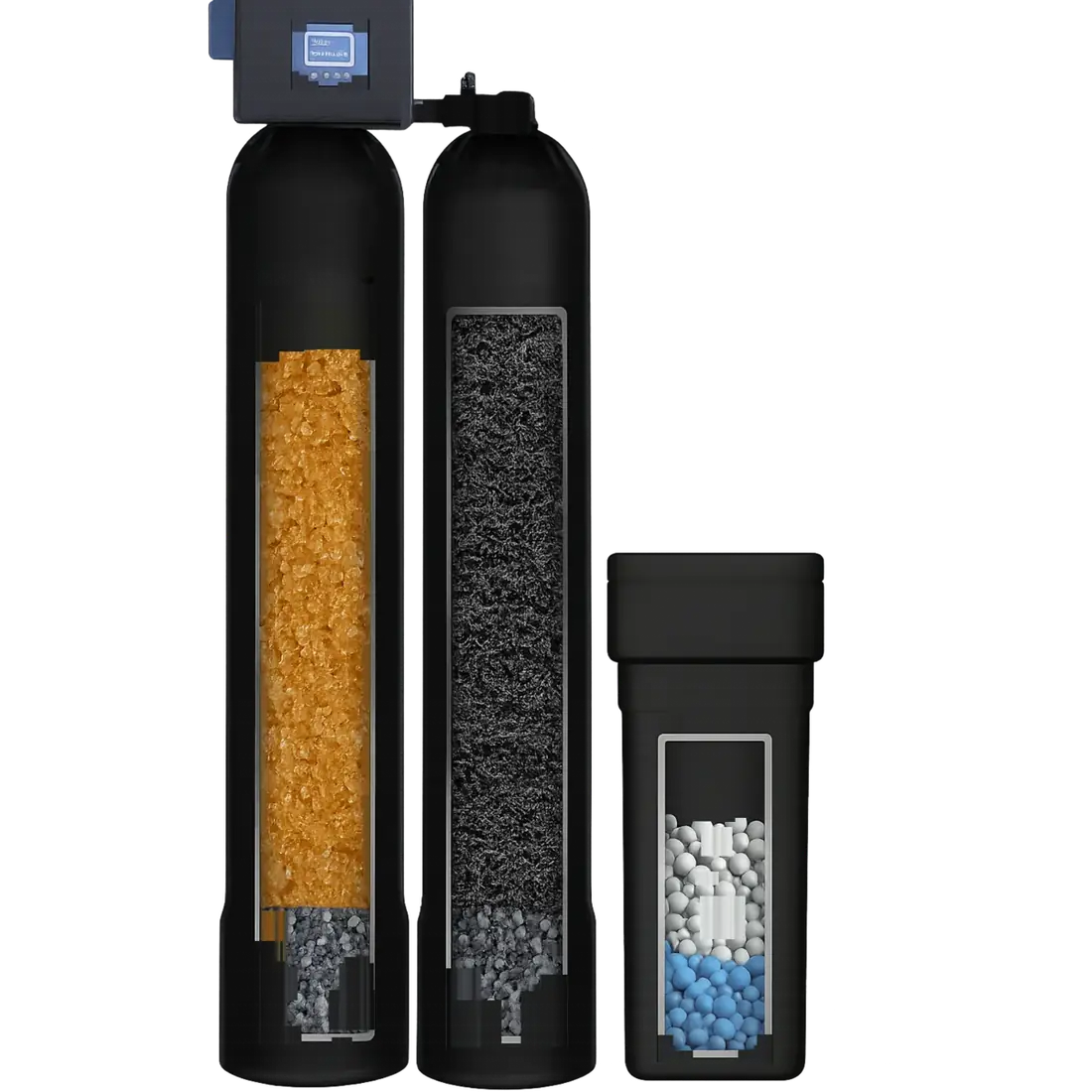
CleanLine's dual-tank arrangement uses a dedicated softening tank and a dedicated carbon filtration tank, plus the softener's brine tank. Keeping the media separate allows each treatment function to be sized and serviced around your water and demand.
Hardness and taste handled separately: The softener reduces calcium and magnesium scale potential. The carbon vessel addresses taste and odor, so homeowners can understand which tank is responsible if a symptom returns.
More straightforward media service: Separate beds allow the softening resin and filtration media to be evaluated independently. They do not have to be assumed to wear out on the same schedule.
Configuration
Two tanks plumbed in series with independent valve heads
Tank one
Food grade softening resin for hardness removal
Treatment limits: This is not a twin-alternating softener with two resin tanks. A separate softener and carbon filter do not, by themselves, guarantee soft water throughout regeneration. They also do not replace well-water iron treatment, microbiological testing or RO for dissolved-solids reduction at the drinking faucet.
We ask about your water and plumbing over the phone and quote the equipment and installation in writing. A licensed, insured and bonded plumber completes the install, usually in a single visit at the garage loop or main line. Before we leave, the valve is flushed and programmed and you know the salt and service intervals and the written warranty terms. If your home has no loop, we quote the plumbing build-out separately, in writing, before any work starts.
Drinking Water Deserves Its Own Stage
Softened, carbon-filtered water protects your plumbing, water heater and skin. For the water you drink, cook with and freeze into ice, add a reverse osmosis system at the kitchen sink with an optional line to the refrigerator.
Whole-home tanks, valves and dry parts carry the coverage described in our warranty. Reverse osmosis equipment carries a 1 year manufacturer warranty. Installation is completed by a licensed plumber.
San Antonio Water Softener FAQs
Is San Antonio water hard or soft?
Hard. San Antonio sits on the Edwards Aquifer, and limestone-filtered groundwater carries a heavy calcium and magnesium load. SAWS' own water quality reports describe the supply as hard to very hard, which matches what we measure at taps across the metro.
Does SAWS soften the water before it reaches my house?
No. SAWS treats and disinfects the water to make it safe, but hardness minerals are left in. Softening happens at the home, at the main line, with equipment the homeowner installs. That is exactly what a whole-home softener does.
How much does a water softener cost in San Antonio?
Our whole-home softening and filtration system is $2,799 installed when your home already has a garage water loop. Homes without a loop need a plumbing build-out, which we price in writing after we see the setup. There is no sales tax on the installed system, and card payments carry a 3 percent processing fee.
Will a softener help my water heater last longer?
Yes. Scale insulates the heating element and settles at the bottom of the tank, so the heater works harder to deliver the same hot water. Removing hardness at the main line keeps the tank and element clean, which is why water heater manufacturers list hard water scale as a leading cause of early failure.
My house is on a well north of the city. Is a softener enough?
Usually not. Well water often carries iron, sediment and sulfur odor along with hardness. We test the water first, then stage treatment in the right order: sediment removal, iron and odor treatment, then softening, then reverse osmosis at the kitchen if you want it. Skipping stages is how resin beds and membranes get ruined early.
Do you install in New Braunfels, Bulverde and Spring Branch?
Yes. We install across San Antonio and the surrounding communities in Bexar and Comal counties, including New Braunfels, Bulverde and Spring Branch, on municipal supply and on private wells.
Get your written installed quote
Tell us about your home. We’ll review your setup, confirm the installation scope and send your written installed quote.